> For the complete documentation index, see [llms.txt](https://www.axisnow.io/zh/docs/llms.txt). Markdown versions of documentation pages are available by appending `.md` to page URLs; this page is available as [Markdown](https://www.axisnow.io/zh/docs/edge/policies.md).
# 策略
AxisNow 的策略概述
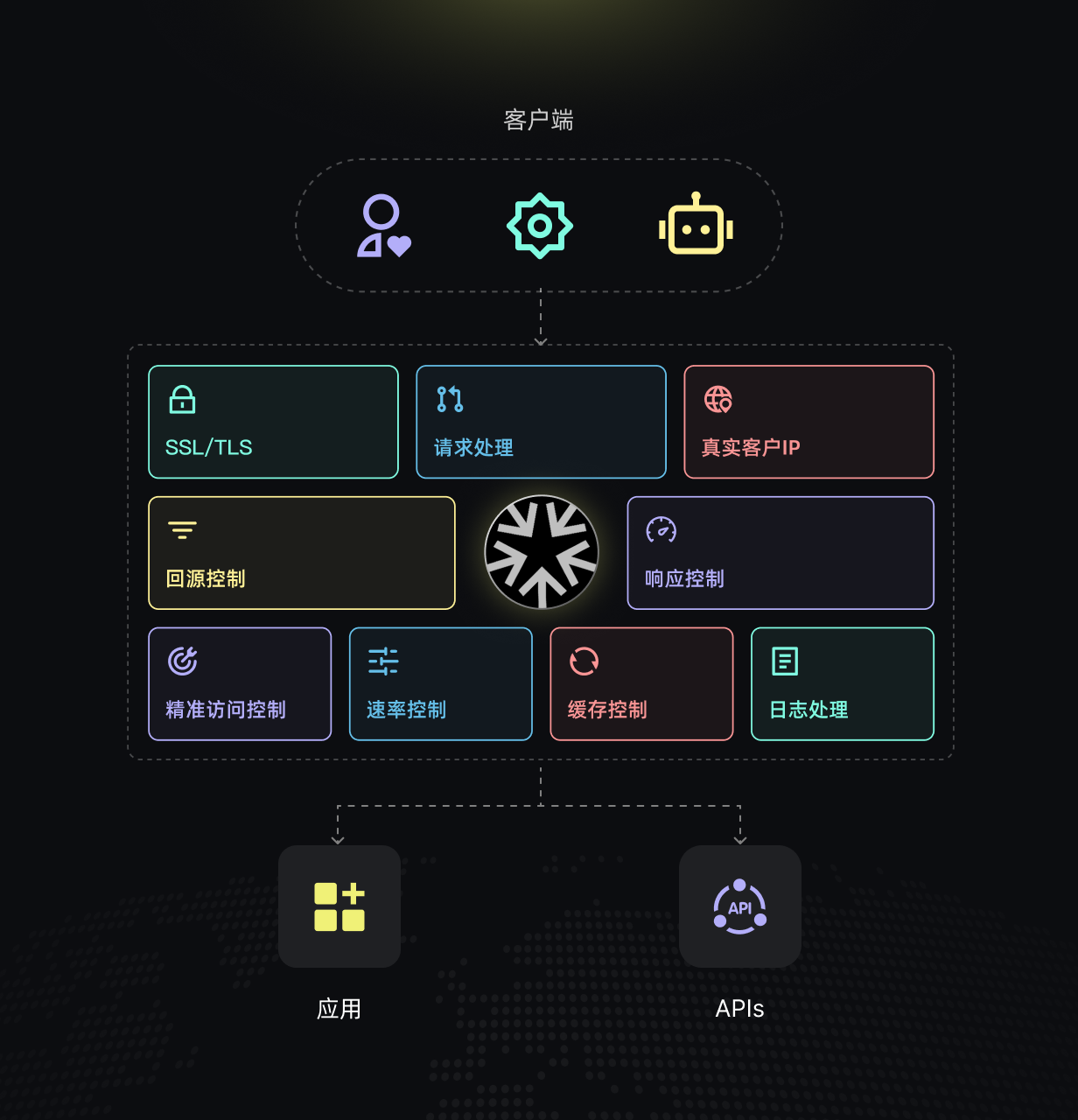
**策略是一项强大的功能,是一系列插件和规则的集合**,是一种在将客户端请求发送到您的服务之前(或在服务的响应发送到客户端之前)调整请求的手段。
AxisNow 的流量管控采用以策略为中心架构(Policy-Centric Architecture)。不同于传统以站点/域名为中心的策略设计,AxisNow 将策略与域名解除耦合,您可以[阅读此篇文章](/zh/docs/edge/architecture/philosophy.md#how-we-keep-it-simple)。这种模式可以类比为:
* **🛣️ 边缘** 相当于高速公路的整体路网 —— 提供统一的通行基础设施;
* **🚗 端点** 相当于高速公路上行驶的车辆 —— 各类应用服务;
* **🚥 策略** 相当于高速公路上的交通管控,负责对车辆的分流、检测、限速与阻断等。
## 插件
AxisNow 通过插件来不断扩展功能,可以灵活组合以适应各种场景。
→ [了解有关插件的更多信息](/zh/docs/edge/policies/plugins.md)
## 对象
对象是一组相同类型数据的集合,可将同类标识符(如 IP 地址、字符串 等)进行聚合。在规则中引入对象通常意味着更少的策略规则,并且更易于大规模管理。
→ [了解有关对象的更多信息](/zh/docs/edge/policies/objects.md)
---
# Agent Instructions
This documentation is published with GitBook. GitBook is the documentation platform designed so that both humans and AI agents can read, navigate, and reason over technical content effectively. Learn more at gitbook.com.
## Querying This Documentation
If you need additional information that is not directly available in this page, you can query the documentation by asking a question.
Perform an HTTP GET request on the following URL with the `ask` and `goal` query parameters:
```
GET https://www.axisnow.io/zh/docs/edge/policies.md?ask=&goal=
```
`ask` is the immediate question: it should be specific, self-contained, and written in natural language.
`goal` is what the user is ultimately trying to achieve, the reason they need the answer. Sharing it helps GitBook give you a better, more relevant answer. A goal is most helpful when it describes the outcome the user wants rather than restating the question. For example, with `ask=how do I create an API token`, a goal like `automate deployments from our CI pipeline` lets GitBook tailor the answer to that use case.
The response will contain a direct answer to the question and relevant excerpts and sources from the documentation.
Use this mechanism when the answer is not explicitly present in the current page, you need clarification or additional context, or you want to retrieve related documentation sections.